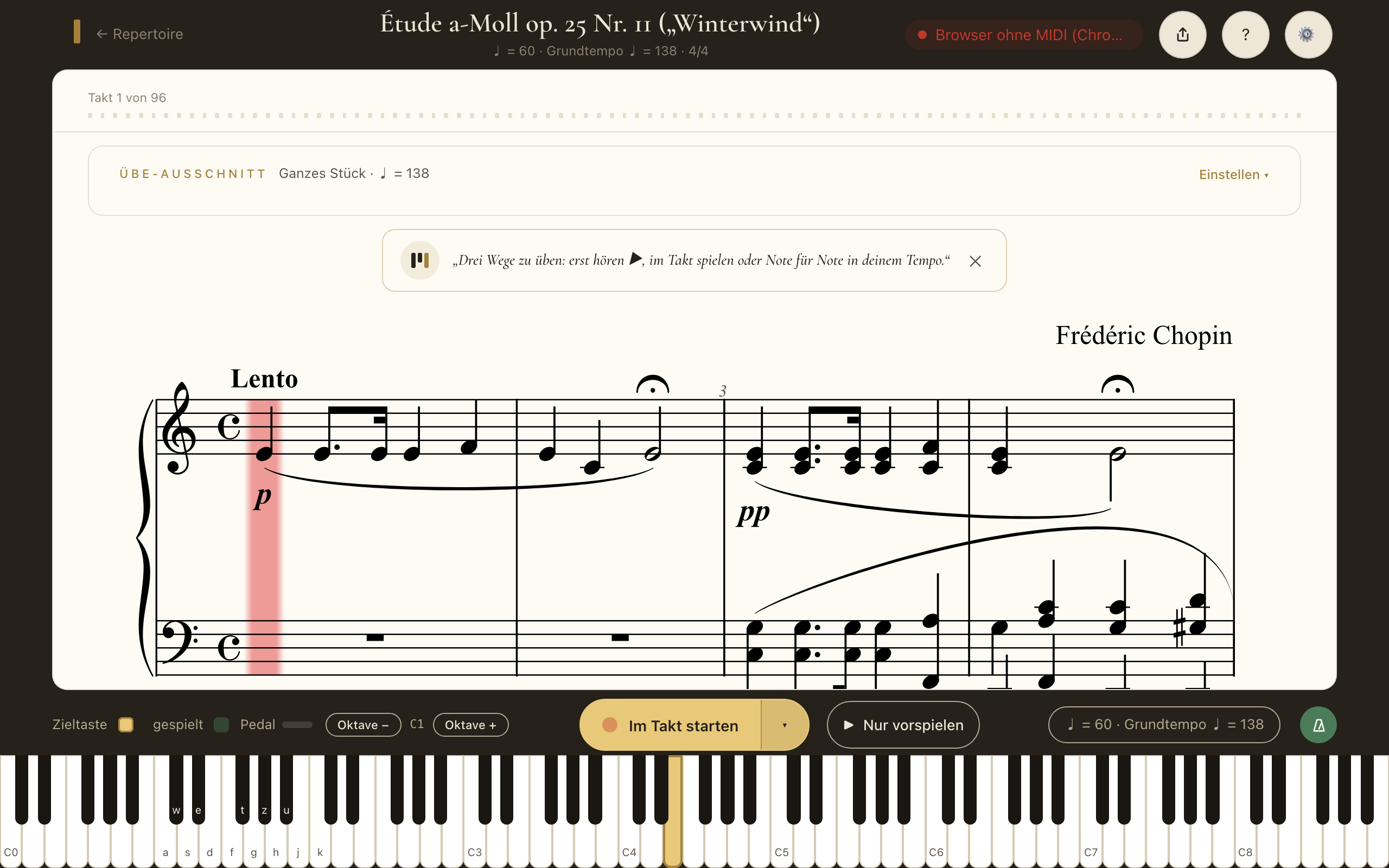
Until now, every piece in Klavissimo had a single tempo. In Chopin's Winterwind that meant even the slow introduction sounded at ♩ = 138. Four pieces now have a tempo plan.
Which pieces, and which tempi
- Chopin, Winterwind (Op. 25 No. 11): bars 1 to 4 Lento at ♩ = 60, from bar 5 ♩ = 138.
- Chopin, Valse in C-sharp minor (Op. 64 No. 2): ♩ = 120, from bar 65 Più lento at ♩ = 100, from bar 97 Più mosso at ♩ = 144, back to ♩ = 120 at bar 129, and ♩ = 144 again at bar 161.
- Debussy, Clair de lune: ♩ = 63, from bar 27 un poco mosso at ♩ = 72, back to ♩ = 63 at bar 51.
- Can-Can: the introduction up to bar 24 at ♩ = 120, the galop from bar 25 at ♩ = 144.
These numbers are playback values we set ourselves. They do not come from the printed scores, which mostly give only tempo words. The notes, bars and entries of the pieces are unchanged.
What changes when you practise
- Playback and metronome follow the plan. If the tempo changes at bar 5, it speeds up there without any setting from you.
- The count-in counts at the tempo of the section you start with. Practise bars 5 to 12 of Winterwind and it counts in Allegro. Start at bar 1 and it counts in Lento.
- The display shows the tempo at the start of your section. If it differs from the base tempo, the base tempo follows. While you play, the display changes at the point where the tempo changes.
- Scoring uses the plan. If you play the Lento slowly, as intended, you are not marked late. The timing windows for correct, early and late stay the same in milliseconds, as for every other piece.
- The tempo control acts on all sections together. Practise more slowly and Lento and Allegro both slow down in the same proportion.
For these pieces the base tempo is still the number listed in the repertoire: ♩ = 138 for Winterwind.
What does not work yet
Gradual slowing down or speeding up, meaning ritardando, rallentando or stretto, is neither played back nor included in scoring. Those passages are left to your playing. This also applies to pieces where they are common, such as Nocturne Op. 9 No. 2.
Your own pieces get a tempo plan only if the file contains the tempo markings explicitly. Klavissimo does not interpret tempo words in the score, such as "a tempo". Pieces you imported earlier keep their single tempo until you import them again.