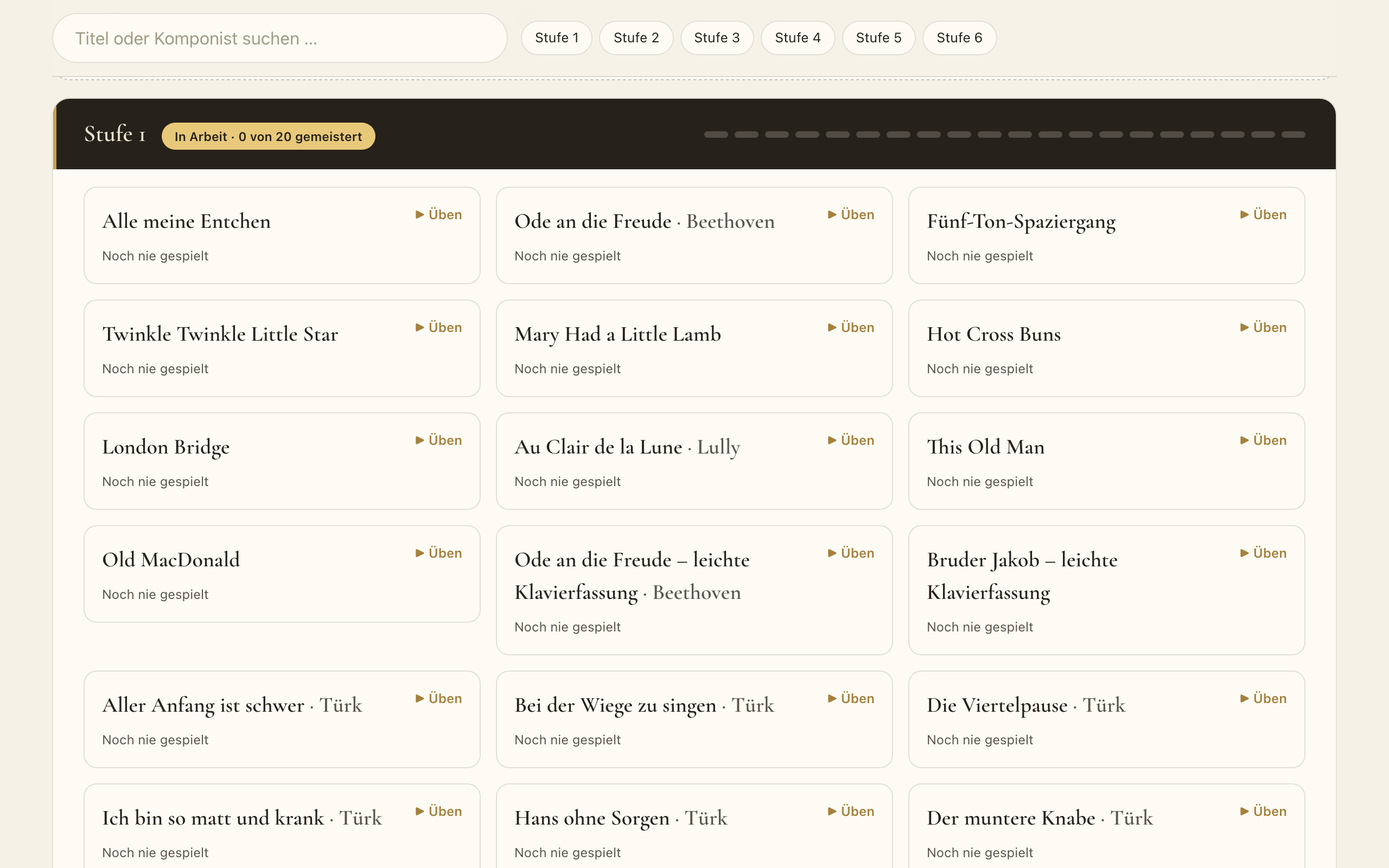
Klavissimo now has 102 pieces and exercises across six levels, 42 more than before. All 42 come from three collections written for piano teaching: Daniel Gottlob Türk’s Handstücke for beginning pianists, Robert Schumann’s Album for the Young, Op. 68, and Friedrich Burgmüller’s 25 Études, Op. 100.
Until now, levels 1 and 2 mostly offered short exercises and simplified tunes. Original pieces now sit there too.
Levels 1 and 2: Türk and the first Schumann pieces
Level 1 has eight short pieces from Türk’s Handstücke, including “Every Beginning Is Hard”, “The Quarter Rest” and “Carefree Hans”. Level 2 adds four more by Türk, such as “The Scale” and “Youthfully Cheerful”, and three pieces from Schumann’s Album for the Young: “Humming Song”, “Chorale” and “Little Piece”.
Levels 3 and 4: Schumann and Burgmüller
This is where most of the new pieces are: 13 at level 3 and 11 at level 4. From Schumann there are, for example, “Soldiers’ March”, “Poor Orphan Child” and “First Loss” at level 3, and “Little Morning Wanderer” and “Little Romance” at level 4. Burgmüller adds “La candeur”, “La pastorale” and “Le courant limpide” at level 3, and “Ballade”, “The Hunt” and “Inquiétude” at level 4.
At level 3, “La candeur” is one of the two pieces you need to master to move on. It takes that place from the Minuet in G major. If you have already mastered the Minuet, it still counts, so you keep your progress. The other 41 new pieces are optional.
Level 5 and tempo
Level 5 has Schumann’s “Knecht Ruprecht” and “May, Dear May” and Burgmüller’s “Tarantella”. For some fast pieces, Klavissimo sets a slower tempo than the printed one. “Knecht Ruprecht”, for example, is set to ♩ = 84, where Schumann marked ♩ = 126. You can set the tempo yourself with the tempo control.
Where the scores come from
Every piece is newly engraved from editions printed in the composers’ lifetimes: Türk from the second edition of 1797, Schumann from the Hamburg first edition of 1848, Burgmüller from Schott’s Mainz edition. You can listen to any piece, choose a passage and practise it with one hand or both.