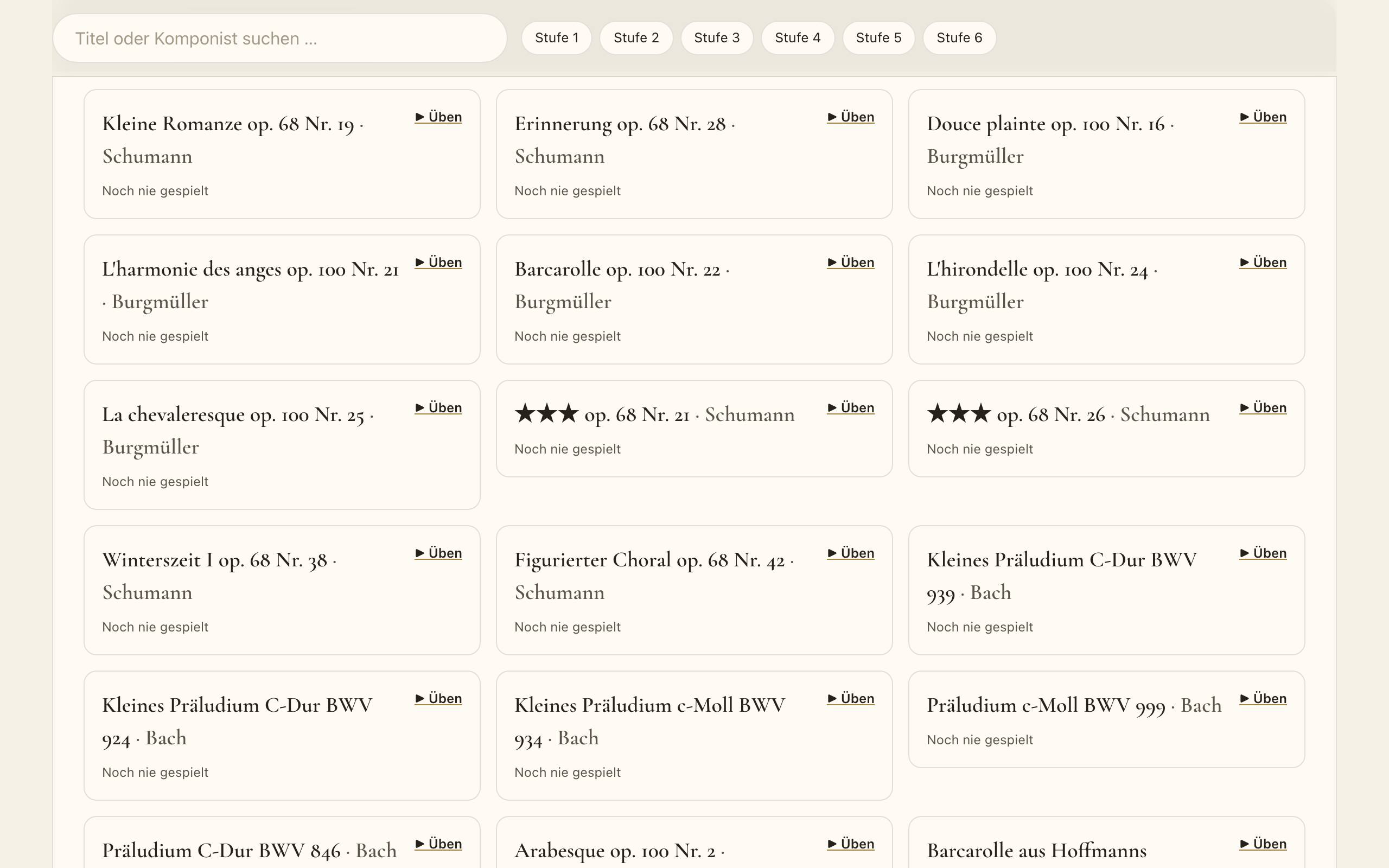
Klavissimo now has 136 pieces and exercises across six levels, 34 more than at the last repertoire update. Most of the news is Bach: twelve pieces from the edition of the Bach-Gesellschaft, published in Leipzig between 1853 and 1894.
Bach: from the Notebook to the Inventions
Four pieces come from the Notebook for Anna Magdalena Bach: the Musette in D major at level 2, and the Minuet in G minor, the Minuet in G major and the March in D major at level 3. Not all of them are by Johann Sebastian Bach. The Minuet in G minor is by Christian Petzold, the March by Carl Philipp Emanuel Bach, and the composers of the Musette and the Minuet in G major are unknown. Klavissimo lists them that way.
Level 4 has three of the Little Preludes (C major BWV 939 and BWV 924, C minor BWV 934) and the Prelude in C minor BWV 999. Level 5 adds the Prelude in C minor from Book I of the Well-Tempered Clavier, and level 6 the Inventions in F major, A minor and D minor.
Burgmüller, Schumann and Türk
Burgmüller adds ten more études from Op. 100, including “La petite réunion” and “Ave Maria” at level 3 and “L'hirondelle” and “La chevaleresque” at level 4. Seven pieces come from Schumann’s Album for the Young, among them “Nordic Song” at level 3 and “Remembrance” and “Winter Time I” at level 4. Türk adds five more Handstücke: four at level 2, such as “The Obliging One” and “Children's Romance”, and “In the Folk Style” at level 3.
Levels and tempo
The 34 new pieces are spread like this: 5 at level 2, 11 at level 3, 14 at level 4, one at level 5 and 3 at level 6. All of them are optional; you don’t need any of them to complete a level.
Where the printed score gives a metronome mark, Klavissimo often sets a slower tempo. “La chevaleresque”, for example, is set to ♩ = 114, where Burgmüller marked ♩ = 152. Most of the Bach pieces have no tempo marking at all, so the tempo in Klavissimo is a suggestion. You can set it yourself with the tempo control.
Where the scores come from
Every piece is newly engraved from a historical edition: Bach from the Bach-Gesellschaft edition, Burgmüller from Schott’s Mainz edition, Schumann from the Hamburg first edition of 1848 and Türk from the second edition of 1797. You can listen to any piece, choose a passage and practise it with one hand or both.