Two changes, both felt while practising: everything for getting started now sits in one place, and what "mastered" means has become more exact.
Practice on one page
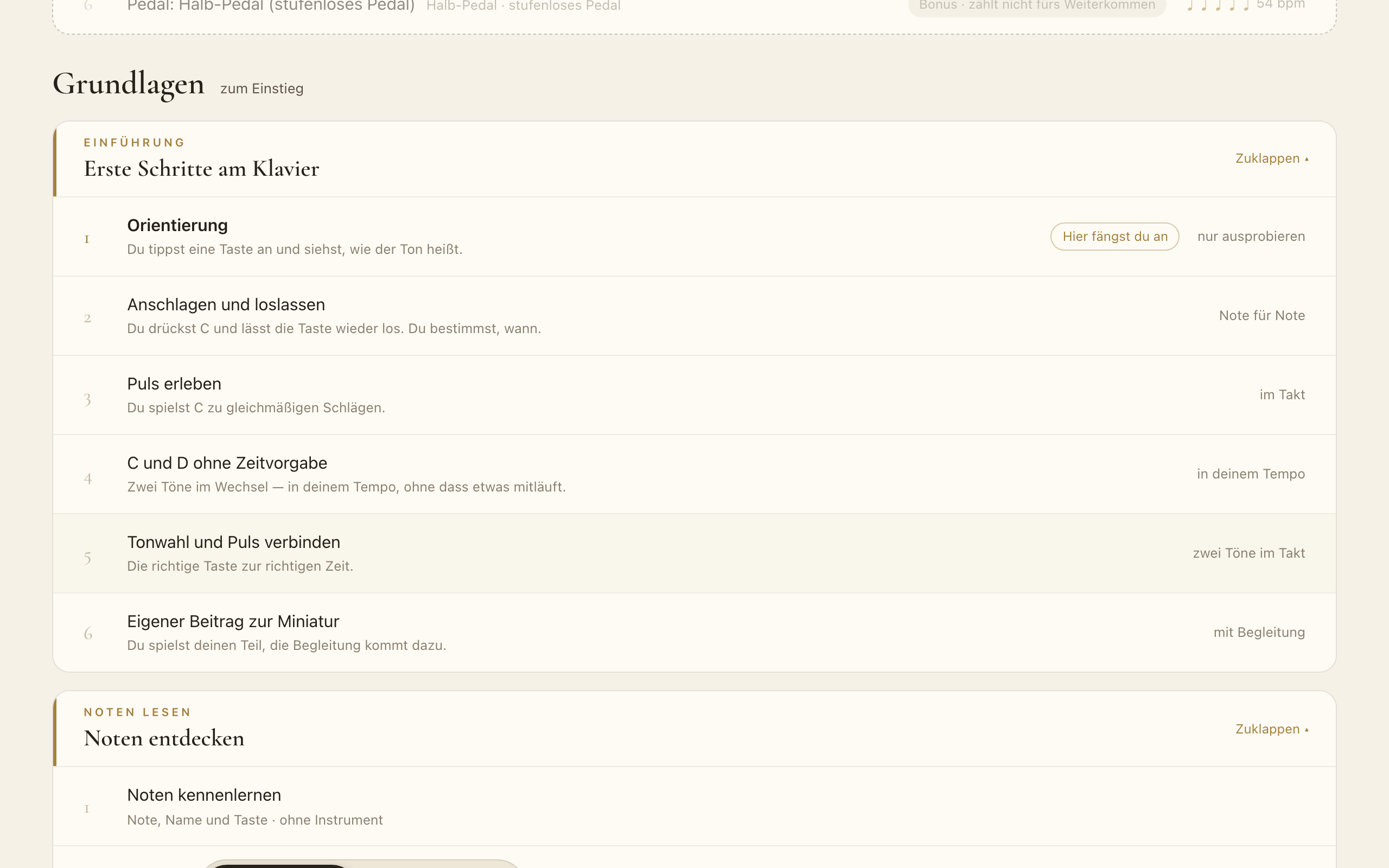
On "Practice", your learning path with its modules is at the top. Below it comes the "Basics" block. It holds "First steps at the piano" with six steps and "Discover notes" with its rounds. Both can be expanded. You no longer need to know that more exercises hide behind another menu item.
Discover notes no longer has a selection screen. Each note group has its own row with a direct start and, where one exists, the "Music →" link. Klavissimo only remembers whether you want to practise with or without orientation.
Choose one hand, the other accompanies
In learning-path exercises where both hands play, you now choose the hand as you do with pieces. If you like, the other hand plays along quietly. The result then says "Right hand practised" or "Left hand practised" and adds: "You practised one hand. The whole exercise stays open." With "Practise with both hands" you start the next run with both hands straight away.
Mastered: whole and with both hands
A run with one hand is a partial step. The result goes into your practice log, but the exercise stays open in the daily plan and the learning path. Right and left hand in two separate runs do not add up to a completion.
The same applies to pieces, where a section is a partial step too. A piece counts as mastered when you have played all of it, every bar, with both hands and a score of 80 or more. If the piece has only one hand, that one is enough. Only such a run counts for the piece ladder.
- What you have already mastered stays mastered. Earlier runs are not re-scored.
- Performing for a teacher still counts: a teacher's performance note weighs as much as a measured run.
- In the daily plan you tick off an exercise only with a run that uses both hands.
For teachers and parents: a run with only one hand now appears in the practice log as a partial step and no longer as mastered.